How to Find the Right Therapist for Your Teen
A Parent’s Guide to Teen Mental Health Support
Parents often know something is wrong long before they know what to do about it.
Maybe your teen has withdrawn from friends. Maybe grades are dropping. Maybe you’re seeing anxiety, anger, substance use, self-harm, or emotional shutdown. And eventually the thought comes: I think my teen might need therapy.
If this is where you are, this guide is for you.
In this guide, you’ll learn how to find the right therapist for your teen so you can move forward with more clarity, confidence, and direction.
Written by Jessica Garbett, MS, LSW — a licensed therapist with over a decade of experience working with teens and families across outpatient, intensive, and wilderness therapy settings.
In This Guide
How to know if your teen needs therapy
Types of therapy for teens
How to evaluate a teen therapist
Red flags to watch for
Why finding the right therapist is so difficult
When families should consider higher levels of care
By the end, you’ll have a clearer roadmap for navigating the process.
How to Know If Your Teen Needs Therapy
Struggle is part of being a teenager. It is also part of developing resilience. Adolescence is heavily influenced by peers and includes rapid emotional, neurological, and social changes.
One of the most common questions parents ask is: Does my teen need therapy, or is this a normal phase?
As a therapist, these are some of the signs I look for when determining whether clinical support may be helpful.
Teen Persistent Mood Changes
Persistent sadness
Frequent anger or emotional outbursts
Emotional numbness or flatness
Sudden mood swings
Teen Withdrawal From Relationships
Isolating from friends
Avoiding family interaction
Spending excessive time alone in their room
Losing interest in previously enjoyed activities
Teen Academic Changes
Sudden drops in grades
Loss of motivation
Skipping school
Difficulty concentrating
Teen Risk-Taking Behaviors
Adolescents naturally experiment, but some behaviors signal elevated concern.
Substance use
Self-harm
Aggressive behavior
Dangerous social choices
Teen Anxiety and Overwhelm
Panic attacks
Avoidance behaviors
Excessive worry
Sleep difficulties
Changes in Teen Sleep or Appetite
Sleeping excessively
Insomnia
Appetite changes
Low energy
Parental Intuition Matters
Parents can often sense when something is wrong before they can identify exactly what it is. If you have tried having a conversation with your teen and your intuition says there is more there, trust your instincts.
It is better to seek help and not have needed it than to need help and not have gotten it.
Any one of the symptoms or behaviors listed above can warrant seeking mental health support. Yes, some of these may be seasonal or connected to a temporary situation that resolves on its own. But if your child has been experiencing or demonstrating any of the above for more than a couple of weeks, there is likely a deeper issue or root cause that therapy can help reveal and address.
Types of Therapy for Teens
Understanding the best types of therapy for teens is a key part of finding the right therapist for your teen.
Not all therapy approaches are the same. Understanding the different modalities can help you make a more informed choice when selecting a therapist for your child. Here I list the top therapies that I believe are most effective for teens.
Cognitive Behavioral Therapy (CBT)
CBT is one of the most researched interventions in mental health. It is a form of talk therapy based on the idea that thoughts, emotions, and behaviors are interconnected.
CBT can be very helpful for teens, especially when they need help identifying thought patterns and learning practical coping skills. That said, I do not believe CBT is always sufficient as a stand-alone intervention, even though it is often used that way.
Dialectical Behavior Therapy (DBT)
DBT is another well-researched approach that works especially well for replacing destructive coping patterns with healthier ones.
One of the things I appreciate most about DBT for teens is that one of its core principles is that two things can be true at the same time. The ability to hold two emotions, two realities, or two desires at once is a vital skill for healthy relationships and emotional maturity.
Like CBT, DBT can be very effective, but I do not believe it is always a stand-alone solution when a deeper issue or wound is present. For example, if a teen has experienced sexual violence and begins self-harming, CBT and DBT may help reduce self-harm and build healthier coping skills. But they may not fully resolve the PTSD driving the behavior. In those cases, CBT and DBT may be excellent short-term supports, but not the whole answer.
Eye Movement Desensitization and Reprocessing (EMDR)
EMDR is most well known for its effectiveness in treating trauma, especially single-incident PTSD.
The basic idea behind EMDR is that traumatic memories can become stuck in the brain and nervous system rather than processed in the way everyday memories are. This can cause the body to react as if the trauma is still happening. EMDR uses a structured process, including bilateral stimulation, to help the brain reprocess traumatic memories so they become less distressing and disruptive.
Internal Family Systems (IFS)
IFS helps teens understand and work with the different “parts” of themselves.
This model focuses on building a strong sense of self, along with self-compassion and internal understanding. I believe IFS can be especially powerful for teens as they navigate identity, autonomy, and belonging.
IFS can be particularly effective for teens dealing with:
Anxiety
Depression
Chronic trauma
Self-esteem challenges
Identity development
Accelerated Experiential Dynamic Psychotherapy (AEDP)
AEDP is one of my favorite attachment-focused interventions.
Attachment is, very simply put, how we form emotional connection with others. It develops primarily in the first 24 to 36 months of life. Attachment wounds can occur when caregivers were unable to be consistently responsive, emotionally available, attuned, or able to provide a safe and trusting environment.
If your child’s early life was challenging, they may now present as a teen with signs of insecure attachment. These can include intense emotional dysregulation, difficulty trusting others, clinginess in relationships, or profound emotional distancing.
The good news is that even if secure attachment was not fully established early in life, healing is possible. Working with a therapist who understands attachment can be deeply helpful.
Experiential Therapies
Experiential therapies are less common, but they can be incredibly powerful. I have spent much of my career providing experiential therapy, and for the right client, these approaches can facilitate change where more traditional therapy could not.
Common experiential therapies include:
Psychodrama
Art therapy
Adventure or wilderness therapy
Somatic experiencing
These approaches move away from heavily cognitive therapy and engage more of the whole body, emotions, and senses. They are hands-on and action-oriented, often helping teens bypass verbal defenses and access deeper change.
These modalities can be especially effective for teens dealing with:
Eating disorders
Substance use
Trauma
Depression
Grief
Personally, I believe that IFS combined with experiential therapies can be an incredibly powerful combination for facilitating meaningful, lasting change in teens.
Family Therapy
Family therapy focuses on the relationships, communication patterns, and dynamics within the family system - not just the individual teen. It often happens in combination with the teen seeing an individual therapist.
One of the most important things to understand is that a teen’s behavior is often influenced by (and impacting) the broader family environment. This does not mean anything is “wrong” with the family, it simply means that change often happens more effectively when the system is involved.
Family therapy can help with:
Improving communication between parents and teens
Reducing conflict and increasing understanding
Addressing patterns that may unintentionally reinforce behaviors
Supporting parents in responding more effectively to their teen
In many cases, individual therapy alone is not enough to create lasting change—especially when challenges show up most strongly at home.
Family therapy can be particularly helpful when:
There is frequent conflict between parent and teen
A teen is shutting down or refusing to engage
Trust has been broken
Parents feel unsure how to best support their child
When done well, family therapy can create alignment, reduce tension, and help everyone feel more equipped to move forward together.
How to Evaluate a Teen Therapist
his is where many families get stuck when trying to figure out how to find the right therapist for their teen.
Other than getting a recommendation from a friend, teacher, doctor, or family member, the most common place people look is an online directory such as Psychology Today or TherapyDen.
Once you are in a directory, you can narrow your list using your non-negotiables, such as:
Cost or insurance
Location
Gender
Faith background or beliefs
In-person versus virtual availability
From there, the goal is to identify the best teen therapist for your child’s needs.
What to Look for in a Teen Therapist
Create a short list by looking for:
Experience working specifically with adolescents
Training and clinical approach that match the type of therapy your teen is likely to need
Questions to Ask During a Consultation
Once you have your short list of 5 to 10 therapists, begin scheduling consultations.
Whether you are searching for a therapist for teens in Denver, looking across Colorado, or considering virtual options across the United States, the same vetting process applies.
Ask these questions:
How do you intentionally build a therapeutic relationship with teen clients?
How do you facilitate communication with parents?
How much involvement do you expect parents to have in the process?
What do you look for to know if treatment is working?
If your teen is willing, I also recommend allowing them to have their own consultations with potential therapists.
Afterward, sit down together and ask:
Who felt the most comfortable?
Who seemed most trustworthy?
Who gave us the most confidence in the therapy process?
If you and your teen have different top choices, I recommend prioritizing your teen’s preference as much as possible. Buy-in matters.
Red Flags: Signs a Therapist Is Not the Right Fit for Your Teen
The vast majority of teen therapists are dedicated professionals who truly want to help. However, dedication does not automatically equal effectiveness, nor does it guarantee that a therapist’s skill set matches what your teen needs.
Here are four red flags to watch for.
#1: Lack of Teen Engagement
If your teen does not like the therapist or does not feel comfortable with them, therapy is unlikely to work regardless of how skilled the therapist may be.
#2: Poor Communication
If the therapist is consistently difficult to reach or communicates in ways that feel unclear or inconsistent, it may be a sign they are overstretched and unable to provide the level of care your family needs.
#3: Vague Treatment Plans
A therapist should be able to explain why they are doing what they are doing. If their answers are consistently vague, it may be a sign that their expertise or clinical clarity is limited.
#4: Lack of Improvement Over Time
Healing takes time, but there should still be markers of progress. Even if you cannot see them clearly yet, your therapist should be able to identify them and communicate them.
Overwhelm: Why Finding the Right Therapist Is So Difficult
There are several unique challenges that make finding the right therapist feel overwhelming and, at times, defeating. Here are a few:
Reliance on Therapist Directories
Therapist directories have real benefits, but they also have major limitations.
First, directories typically do not vet therapists beyond license verification and, in some cases, years of experience. Second, therapists can describe themselves however they want without having to prove depth of expertise.
For example, if you search “teen therapy near me” or “therapist for teens in Denver, CO,” you will likely see hundreds of results.
I recently searched for therapists in Denver who said they work with anxiety and ADHD. I received more than 500 results. I narrowed it further to therapists who said they work with anxiety, ADHD, and teens and still received more than 500 results. I narrowed it again to zip code 80111 and still received more than 500 results.
This is why relying only on therapist directories can feel overwhelming and not especially helpful. It also shows how therapist marketing does not always equal real expertise.
Could all of those therapists work with teens struggling with ADHD? They seem to think so. Will all of them be experts or the best fit for your teen? Almost certainly not.
This is why consultations matter. They help you understand the therapist’s approach, style, and experience in a more meaningful way.
If you are not a therapist yourself, this process can feel overwhelming in its own right. That is exactly why I created Therapy Compass: to help parents make thoughtful, informed decisions without having to navigate the mental health system alone.
Trial-and-Error Is the Norm
nother reason it is so difficult to find the right teen therapist is that “trying out” therapists has become the norm.
Many people seeking therapy meet with multiple therapists over the course of several months before finding someone who feels like the right fit. That costs time, money, and emotional energy that is often already depleted.
For teens, the impact of this process can be even more significant.
Unlike adults, most teens are not the ones initiating therapy. They may already feel hesitant, skeptical, or unsure about the process. It often takes a meaningful amount of courage just to show up to the first session.
When that first experience does not feel like a fit, teens often do not think, “That therapist was not right for me.”
Instead, they may internalize the experience as:
“Therapy doesn’t work for me.”
“I’m too messed up.”
“No one really understands me.”
“There’s no point in trying again.”
Once that belief sets in, it can be difficult to re-engage them. This is the true cost of trial-and-error therapy.
This is one of the biggest reasons why learning how to find the right therapist for your teen upfront matters so much.
If your feeling overwhelmed by the therapist search?
Book a free 15-minute Therapy Compass fit consultation
High Demand for Teen Therapists
Despite what a directory may suggest, teen-specific therapists with openings are often difficult to find.
When you step back and consider the unique pressures today’s teens are facing, that is not surprising.
Parents who feel desperate often say yes to the first available therapist. That makes sense. But getting an appointment should not come at the expense of proper vetting.
Even when you feel pressure to move quickly, taking time for consultations and thoughtful research can dramatically improve the odds of finding the right therapist match.
When Families Should Consider Higher Levels of Care
Part of finding the right therapist for your teen is understanding when weekly therapy alone may not be enough.
Before anything else, I want to make clear that this decision, more than most, should be made in collaboration with a licensed mental health provider.
What Are Higher Levels of Care?
I define higher levels of care as any treatment structure that provides more than the one to two hours per week typically offered in traditional outpatient therapy.
As urgency and severity increase, the hours of support usually increase too.
Approximate Hours of Care by Level
Outpatient therapy: 1 to 2 hours per week
IOP (Intensive Outpatient Program): 9 to 15 hours per week
PHP (Partial Hospitalization Program): 20 to 30 hours per week
Residential treatment: 24/7 support for 30 days or more, or roughly 168 hours per week
Inpatient hospitalization: 24/7 acute stabilization, often for 3 to 7 days
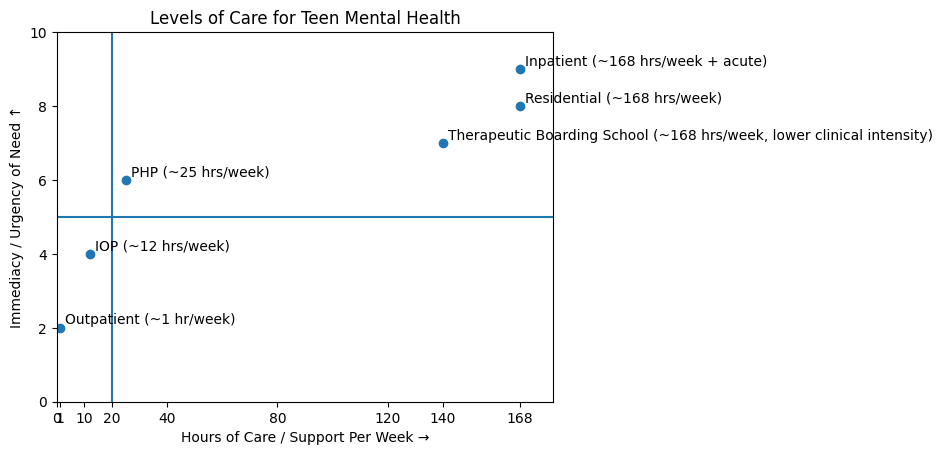
This image describes the relationship between mental health urgency and the hours of support provided when looking at levels of mental health care.
Understanding Severity: It Often Comes Down to Teen Safety
For example, a teen experimenting with substances may be concerning to a parent. But if:
their grades are stable
they are not getting into trouble at school or with the law
their behavior is not putting them or others at immediate risk
then a higher level of care may not be necessary.
However, if that same teen is using substances in a way that:
puts their physical health at risk
involves dangerous situations
impacts others’ safety
then a higher level of care should be explored.
The Same Is True for Depression
Not all depression requires intensive treatment.
There is an important difference between:
Passive suicidal ideation, such as “I wish I wasn’t here”
Active suicidal intent, planning, or attempts
Both are serious. Both deserve attention. But they often require different levels of intervention.
A teen experiencing passive thoughts may be appropriately supported in outpatient therapy with the right therapist and family involvement.
A teen with active intent, planning, or suicide attempts may require immediate and higher levels of care to ensure safety.
Why This Distinction Matters
Many families understandably react to distress with urgency. But the goal is not simply to choose the highest level of care available. It is to choose the right level of care for your teen’s current needs.
Too little support can leave teens struggling. But too much intensity, too soon, can also be overwhelming, unnecessary, and sometimes counterproductive.
Instead of asking, “How serious is this?” it can be more helpful to ask:
Is my teen safe right now, and what level of support will best help them move forward and thrive?
This is one of the most important decisions you will make for your teen, and it is one you do not have to make alone.
You Don’t Have to Figure This Out Alone
f you are reading this, you are likely already doing what so many good parents do: paying attention, asking questions, and trying to find the best support for your teen.
But as you have probably realized, knowing your teen needs help and knowing how to find the right help are two very different things.
If you are not a therapist, this process can feel overwhelming in itself. That is exactly why I created Therapy Compass: to help parents make thoughtful, informed decisions without having to navigate the mental health system alone.
Start With a 15-Minute Fit Consultation
If you are feeling unsure where to start, I offer a free 15-minute consultation to help you:
Talk through what is going on with your teen
Determine whether Therapy Compass is the right fit for your family
Gain immediate clarity on your next step

Jessica Garbett, MS, LSW
Licensed Therapist | Founder, Therapy Compass
Helping parents find the right therapist for their teen—without months of trial and error.
Guidance rooted in real clinical experience across muiltiple levels of care.
Get Clarity on the Right Next Step for Your Teen
Frequently Asked Questions About Finding a Therapist for Your Teen
-
If your teen is showing persistent emotional, behavioral, relational, academic, or physical changes for more than a couple of weeks, therapy may be worth exploring. Common signs include withdrawal, sadness, anxiety, anger, self-harm, declining grades, and changes in sleep or appetite.
-
The best therapy for teens depends on what is driving the struggle. CBT and DBT can help with coping skills and emotional regulation. EMDR can be effective for trauma. IFS, AEDP, and experiential therapies may be especially helpful when the issue is unknown, for deeper wounds, attachment or relationship issues, identity development, or chronic trauma is suspected.
-
Start by narrowing your search based on practical needs like cost, location, and insurance. Then evaluate therapists based on their experience with adolescents, clinical training, and fit with your teen’s needs. Consultations are one of the best ways to assess therapeutic fit before starting.
-
A higher level of care may be appropriate when a teen’s symptoms become severe enough that weekly outpatient therapy is not sufficient. This is especially true when safety becomes a concern, such as active suicidal intent, dangerous substance use, or significant functional decline. If you suspect this is needed for your teen, speak to a professional.
